- chapter notes for the little typer
- 2026-01-01
review
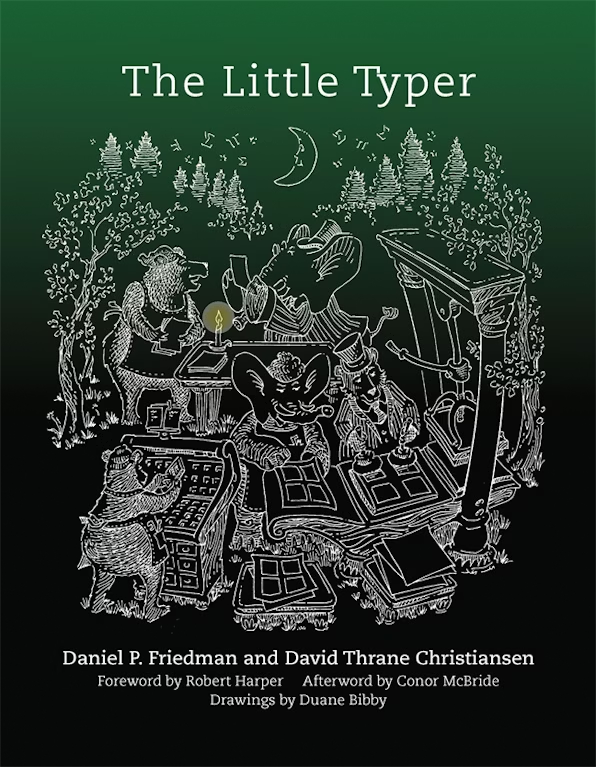
the little typer, by MIT Press
That was quite the odyssey into the arcane realm of dependent types. At the outset, I was not interested in the logic itself, but in the power it can confer. The types constructed are much more expressive than we see in traditional statically typed languages, à la Java, C/C++, OCAML, Scala, and Haskell. In dependently typed languages, construction can be interpreted as a form of proof–that is, finding a program P with type T is proof of the logical statement that T encodes. Claiming T is all fine and good, but proving it requires finding a program that the compiler accepts.
That might be the paradigm shift these type of languages make. But as good as this sounds, they might not be practical for most programming needs. They probably don’t scale well when developing much larger programs like OSes, games, browsers, etc. Additionally, on the other end of the spectrum, they are not worth the time for simple scripts. Nevertheless, they are worth knowing about. If you want to proceed further down the rabbit hole, graduating to more advanced dependently-typed languages used for making real programs, then roughly, there seems to be two paths: (1) developing runnable programs, and proving properties about them, or (2) developing theorems just to prove them; essentially doing mathematics with machine-checked proofs. Idris has positioned itself for the former with Roq/Lean/Agda purpose-built for the latter. For me, looking into Idris would be a next step–at least just to see what real programs are being built using this newfound knowledge.
As a reference, the little_typer_dialog.pie is the code (most of it) the book uses to teach you this new language. Below are the notes by chapter(s):
Chapters 1-2: Getting Definitions Down
In the preface, the text mentions what is meant by Laws and Commandments. It’s worth spending some time to digest these terms before proceeding. You will need to do as such in the first few chapters since much of this text relies on understanding the precise meanings of its definitions. But don’t sway into thinking this is an intractable computer science monograph on type theory–it strikes a good balance between not being too academic and still allowing you to swim in the deep end of the pool. Very much living up to its playful artwork and cover.
With this framing in mind, now on to the definitions! Laws determine what expressions mean, while Commandments determine when two expressions mean the same thing. The first law you encounter (The Law of Tick Marks) defines which expressions are atoms. 'pear is an atom in accord with this law but the expression '42 is not. Next you will see the Commandment of Tick Marks indicating when two atoms are the same. You will want to make sure you understand the laws before looking at their respective commandments.
Another concept worth mulling on is what is meant by a judgment. Looking at the first four templates provides some insight. Filling in all the blanks in a template produces a judgment. Whether or not that judgment is believable is a different concern.
- ______ is a ______.
- ______ is type.
- ______ is the same ______ as ______.
- ______ and ______ are the same type.
I should have mentioned earlier that the language used in the book is called Pie. These judgments describe the rules the typechecker must follow. They determine whether computations are well-typed and therefore meaningful. Each judgment relies on one or more presuppositions. For example, the form ______ is a ______. requires:
- the first blank to be an expression
- the second blank to be an expression that is a type.
'pear is a Atom. is an example of a judgment that is believable but 'pear is a 'fruit. or 'pear is a Pair(Atom, Atom). are not. In both cases we don’t believe them: 'fruit is not a type and an Atom is not the same as a Pair.
In Pie everything is a pure expression except there are two special forms: claim and define. Both accept a name and an expression as arguments. claim asserts the type by name while define associates a name with the expression. Every define needs a corresponding claim. The text then goes on to describe the different kinds of expressions: values, normal forms, and neutral. Values and normal forms are straightforward concepts that don’t need much elaboration, but an example will suffice:
; a value, since it has the add1 constructor at its top
(add1 (+ zero (add1 zero)))

; also the same value, but in its reduced normal form
(add1 (add1 zero))
Neutral expressions are more subtle. They are not values, and cannot be reduced any further due to an unknown variable. They are kind of stuck in limbo or purgatory until context is provided.
; context is:
;   y is the Atom 'fruit
;   x is a (Pair Atom Atom)
;   z is a Nat

; neutral expressions
(car x)
(car (cons x y))
z

; these are not, since they are values because
; the constructor is at the top
(add1 (+ z z))
(cons (car x) (cdr x))
One minor nuisance in these first chapters is that many expressions are well-formed but not directly runnable without type annotations. The following example won’t work:
; will not compile :(
(car
    (cons
        (cons 'aubergine 'courgette)
        'tomato))
It will complain about not being able to determine the type. You can annotate the expression with the:
(car
    (the (Pair (Pair Atom Atom) Atom)
        (cons (cons 'aubergine 'courgette)
            'tomato)))
Types are themselves expressions, and their type is U (universe). The type for Nat, Atom, etc. is U. Type expressions being treated like value expressions is what gives types first-class privileges in Pie. You can use U with the like below:
(Pair
    (car (the (Pair U Atom)
        (cons Atom 'olive)))
    (cdr (the (Pair Atom U)
        (cons 'oil Atom))))
Lastly, some of the examples use the + operator. This will be defined in future chapters; for now, you can download add.pie to run those examples and follow along until addition is introduced properly.
Chapter 3: What is a Proof, What is a Value
There is a subtle connection between computation and traditional mathematical logic:
- programs are proofs,
- types are statements (or propositions), and
- to find a proof is equivalent to writing a program that the compiler accepts.
In Pie all programs are expressions that are either values or almost values (neutral). A value can be viewed as a proof. Proof of what? Proof of whatever its type is. What about the case when an expression has no value? That means there is no proof, or whatever the statement is encoded in its type is false. An example will solidify this:
; You haven't seen `=` but it is a type constructor (like Pair)
; where its arguments are equal w.r.t. some type.
;
; Pie will allow this claim (below) but coming up with a program
; for it will never work, but let's relax that for now.

(claim bogus
    (-> Nat
        (= Nat zero (add1 zero))))

(define bogus
    (lambda (n)
        (bogus n)))
Let’s assume Pie allowed recursion. Then such a definition would be completely reasonable. In the body of bogus I need to return the type (= Nat zero (add1 zero)). Well, why not return (bogus n) which conveniently provides this exact type.
- But this results in an infinite recursion and never produces a value
- But according to Pie, the definition of bogus is reasonable proving the claim that if I provide any Nat, then 0 must equal 1
Pie resolves this fatal flaw by disallowing recursion in this manner. With this omission, programs now produce values, and can be stashed in types and the Pie compiler can be assured that computing types would never result in an endless loop.
Chapter 4: ->’s Stronger Brother Pi
Our friend -> has already been used to type lambdas. But now we get introduced to Pi, which gives us what other languages call generics. With it, we can now define an eliminator for the generic (Pair A D) where A and D are any types in U:
(claim elim-Pair
  (Pi ((A U) (D U) (X U))
    (-> (Pair A D)
        (-> A D
            X)
        X)))

(define elim-Pair
  (lambda (A D X p f)
    (f (car p) (cdr p))))
Pi is like -> but can also take on arguments that get substituted in Pi bodies. (elim-Pair Nat Atom Nat) computes the type:
(-> (Pair Nat Atom) (-> Nat Atom Nat) Nat)
which describes some lambda expression. Something -> was not able to do on its own.
Chapters 5-6: Lists and Vectors
If we wanted to create list of things and we only know about pairs one way to encode this (tediously) is:
; Avoiding empty lists, `base-num-type` is the type for
; lists of one element.
(claim base-num-type U)
(define base-num-type (Pair Nat Atom))

; Make our list type `Num` one element larger by wrapping it
; inside a new pair type with a `Nat`.
(claim cons-num-type
  (Pi ((Num U))
    U))
(define cons-num-type
  (lambda (Num)
    (Pair Nat Num)))

; Constructor for creating one element lists
(claim base-num
  (-> Nat
      base-num-type))
(define base-num
  (lambda (n)
    (cons n 'nil)))

; Constructor for creating lists one element larger
(claim cons-num
  (Pi ((num-type U)
       (nums num-type))
    (-> Nat
        (cons-num-type num-type))))
(define cons-num
  (lambda (num-type nums num)
    (cons num nums)))
Here is a session log creating a one element list and consing to it twice:
> (base-num 69)
(the (Pair Nat Atom)
  (cons 69 'nil))

> (cons-num base-num-type
    (base-num 69)
    42)
(the (Pair Nat
       (Pair Nat Atom))
  (cons 42
    (cons 69 'nil)))

> (cons-num (cons-num-type base-num-type)
    (cons-num base-num-type
        (base-num 69)
        42)
    0)
(the (Pair Nat
       (Pair Nat
         (Pair Nat Atom)))
  (cons 0
    (cons 42
      (cons 69 'nil))))
As you can see this is not workable. In these chapters we are introduced to two new list types: lists and vectors. Lists are cons structures with type (List E) for some E in U along with the constructors :: and nil. It has one eliminator named rec-List. Vectors are lists, but their corresponding length is part of the type–making it the first dependent type introduced. Its type looks like (Vec E k) for some E in U and k in Nat. It has constructors vec:: and vecnil. The only eliminators presented are head and tail. At the moment we have no eliminator as powerful as the rec-List analog.
The most salient concept in these chapters is that of a total function. Let’s claim I have a function bogus-first that takes the head of a vector. As described here bogus-first cannot be implemented in Pie because it’s not total. There is no (bogus-first vecnil) program/value so Pie will reject the following claim:
(claim bogus-first
  (Pi ((E U) (l Nat))
    (-> (Vec E l)
        E)))

; will not compile since `es` type does not have `add1` at top
;(define bogus-first
;  (lambda (E l es)
;    (head es)))
One simple approach to resolve this is to make first return (Option E) instead of E which would now make it total. But Pie mentions a more idiomatic approach in the principle Use a More Specific Type. Make first take a vector with at least one element in it. That would look like:
(claim first
  (Pi ((E U)
       (l Nat))
    (-> (Vec E (add1 l)) ; <-- vectors of length l+1 as input
        E)))
(define first
  (lambda (E l es)
    (head es)))
Now first is total, since it works on all vectors of at least one element.
Chapter 7: ind-Nat is a Dependent rec-Nat
We meet ind-Nat for when rec-Nat is not up to the task. The trivial example to motivate us quickly is: building a vec of atoms with a particular length in mind. rec-Nat is not capable of implementing this simple program since it cannot vary the types depending on the target:
> start with an empty vector to get
  vecnil
  with type (Vec Atom 0)

> add one 'a in the step to get
  (vec:: 'a vecnil)
  with type (Vec Atom 1)

> add one 'a in the step to get
  (vec:: 'a (vec:: 'a vecnil))
  with type (Vec Atom 2)

> ... do this n-3 more times ...

> add one 'a in the step to get
  (vec:: 'a ... (vec:: 'a (vec:: 'a vecnil))...)
  with type (Vec Atom n)
As you can see the type changes in each step of the recursion, thus we need a dependent type that takes Nats from [0, n]. ind-Nat accepts this dependent type as one of its arguments. This argument is called the motive and is used in other inductive expressions.
We have come a long way since which-Nat. iter-Nat was needed when which-Nat could not do recursion. rec-Nat combined both iter-Nat and which-Nat for when you might want access to each element in the recursion. Now, it is superseded by ind-Nat which can do everything prior, plus more, when dependent types are involved.
Chapters 8-9: Proving Properties About Programs
The difficulty ramps up a bit in these chapters. The type constructor equals (i.e. =) is introduced along with its same constructor and a cadre of eliminators: cong, replace, and symm. same is a way to construct evidence for an expression, which is what is needed at the base case of induction. During each step of the induction we need eliminators to construct evidence_k from given evidence_k-1. If we can achieve this we have evidence_n, or proof of the statement the type encodes.
Let’s start with cong since it’s simpler than replace. It takes two arguments. The first is evidence_k-1 which has type (= X from to). If you want to prove (= X (f from) (f to)) and you can find some f, then evidence_k will be (cong evidence_k-1 f). Here is the example from the book using cong:
; base case
(claim base-incr=add1
  (= Nat (incr zero) (add1 zero))) ; (= Nat 1 1)
(define base-incr=add1
  (same 1)) ; same constructor for base case

; the step proves that:
;   for every Nat n
;   if (incr n) equals (add1 n)
;   then (incr (add1 n)) equals (add1 (add1 n))

(claim step-incr=add1
  (Pi ((n-1 Nat))
    (-> (= Nat
          (incr n-1)
          (add1 n-1))
        (= Nat
          (add1 (incr n-1))
          (add1 (add1 n-1))))))

(define step-incr=add1
  (lambda (n-1)
    (lambda (evidence_k-1)      ; given evidence
      (cong                     ; cong eliminator for inductive step
        evidence_k-1 (+ 1)))))  ; evidence_k with f = (+ 1)
Understanding these chapters required multiple readings. If cong is not clear, take a break and start the chapter again with a fresh mind.
replace is a complex beast. At first it is not clear what it does. When to use it is simpler since cong can only work on and return equality types. replace can work on an equality type but return any type described by its motive. It takes three arguments with the first being the target evidence with type (= X from to). The third argument is the base, which is an expression that is close to the one you want, but you need to do some minor surgery to get it just right. The middle argument is the motive, which is a function that takes from and to from the target evidence and uses them to construct the types for the base and whole replace expression, respectively.
The example to implement twice-Vec should clear up replace, and what purpose each argument is for. Below we implement twice-Vec, making use of the proof twice=double and the function double-Vec. Using these parts, replace can help us implement twice-Vec. double-Vec with type (= Vec E (double l)) is the base that is very close to the type we want: (= Vec E (twice l)). We also know twice equals double, but with symm we can rearrange the order to double equals twice and pass that as the target to replace. replace will allow us to return the result of double-Vec for twice-Vec since it can now transform the type from (= Vec E (double l)) to (= Vec E (twice l)) using the target, motive, and base.
(define twice-Vec
  (lambda (E l)
    (lambda (es)
      (replace
        (symm (twice=double l)) ; <-- target
        (lambda (k)             ; <-- motive
          (Vec E k))
        (double-Vec E l es))))) ; <-- base
Chapters 10-11: Induction on Lists and Vecs
We are introduced to a new type constructor: Sigma – which encodes the there exists operator from classical logic. As a recap we can now say the following in Pie’s type system:
- Whether something is a
Nat,Atom,List,VecorPair(which isSigma) - Whether both statements are true (and) … using
Pair - Either or statement (or) … using
Either(introduced in Chapter 13) - Equivalence, if and only if … using
= - If P is true, then Q is true (P implies Q) … using
-> - For all … using
Pi - There exists … using
Sigma
With Sigma now in our toolbox, we set out to implement a new helper: list->vec. While possible, this results in specious definitions such as vecs that have a length that don’t correspond to the input list. We overcame this deficiency by tying the length of the list argument to the vector length as its type:
(claim list->vec
  (Pi ((E U)
       (es (List E)))
    (Vec E (length E es)))) ; <-- vec has length of `es` now
But this means we need to upgrade from rec-List to ind-List to complete the implementation. ind-List will do induction on each element of the list and the motive argument will allow us to return correct vector type in each step:
(define mot-list->vec
  (lambda (E)
    (lambda (es) ; <-- each step has the vec length
      (Vec E (length E es)))))
Chapter 10 concludes that even this definition suffers from specious implementations. For example, returning an appropriate-sized vector but the order is reversed, or just some of the elements are swapped. Unfortunately, the type doesn’t preclude these definitions. To resolve this, we need not change the type again, but delegate to an external proof to help:
; For every list `es`
;   `es` is equal to itself converted to
;   a vec and then back to a list

(claim list->vec->list=
  (Pi ((E U)
       (es (List E)))
    (= (List E)
       es
       (vec->list E
         (length E es)
         (list->vec E es)))))
We proceed to make a definition for list->vec->list=, which is proof that the list turned into a vec using list->vec is indeed a vec with the same elements and order.
Chapters 12-13: Even and Odd
These chapters don’t introduce any new concepts (except (Either L R)), but build on our knowledge to develop the dependent types: (Even n) and (Odd n). We proceed to prove very simple properties about even and odd numbers:
- adding 1 to an even produces an odd
- adding 1 to an odd produces an even
- every number is either even or odd (using the above proofs)
In theory, you can now employ these types in programs. For example, you could want a function that takes in a number (Even n) and doubles it:
(claim even-doubler
  (Pi ((n Nat))
    (-> (Even n)
      (Even (double n)))))

(claim twelve-is-even (Even 12))
(define twelve-is-even
  (cons 6 (same 12)))

; it can be called like (even-doubler 6 (Even 6)) and it will return twelve-is-even
; which has the type (Even 12)
Chapter 14: The Absurd Type
If the type Trivial has one value, then what type has zero values? Absurd does; a program with a type that has Absurd in it cannot be defined. Strangely, it does have an eliminator (no constructor) in ind-Absurd, but this is to satisfy the type checker in expressions. A clever demonstration of this is in defining vec-ref. The types involved here are rather complex. But we want a vector of length 0 to have no 2 index position in (vec-ref Atom 0 2 vecnil), and Absurd will work here to let the compiler flag this as an error. Getting the head position of a vector of length 2 should be no problem and return Atom: (vec-ref Atom 2 0 vec-of-len-2).
To define vec-ref we will need to create a type of numbers that index the vector. The numbers will have a notion of the position in the vector they point at, as well as the length of that vector too. Each layer down in the index number will work with a vector of length one less. The length in the index number will also match the same length of the vector we are trying to index. Such a type of vec-ref could look like:
(claim vec-ref
  (Pi ((E U)
       (l Nat))
    (-> (Fin l) (Vec E l)
        E)))
(Fin l) is the type of this index number for some length l, of which is the same length of the vector (Vec E l). In coordination we can convince the type checker that we can safely index this vector.
It is now obvious that the target is l and we should implement this using ind-Nat. The base case will never be used since for it to typecheck the number (Fin l) must match the length of the vector. So this is safe by construction. However, ind-Nat still requires a base case and an expression using ind-Absurd returning E will appease the type checker:
(claim base-vec-ref
  (Pi ((E U))
    (-> (Fin zero) (Vec E zero)
        E)))
(define base-vec-ref
  (lambda (E no-value-ever es)
    (ind-Absurd no-value-ever
      E)))
The inductive step on ind-Nat is about peeling off layers of the index number l. But I haven’t mentioned how this index number or its type look like. This is the most clever part: (Fin l) is a dependent type that builds:
- Absurd when l=0
- (Either Absurd Trivial) when l=1
- (Either (Either Absurd Trivial) Trivial) when l=2
- and so on …
So if we have a vector of length 3 then (Fin 3) will have 3 Eithers nested in its type, which in this case represents a vector with 3 valid index positions. The index positions have constructors: fzero and fadd1. fzero represents the index number term for the head position, and fadd1 gives you subsequent index terms, pointing somewhere in the tail position.
Finally, the step uses this representation and ind-Either to decide on whether to call head or tail on the vector. With the base case and step we have all the parts to assemble the definition for vec-ref:
(define vec-ref
  (lambda (E l)
    (ind-Nat l
      (lambda (k)
        (-> (Fin k) (Vec E k)
            E))
      (base-vec-ref E)
      (step-vec-ref E))))
Chapters 15-16: CL = IL + DNE
Expressing refutation of P or not P was our last remaining logical analog. We can now express that (+ 2 2) does not equal 5 as a type:
(claim two+two!=five
  (-> (= Nat (+ 2 2) 5)
      Absurd))
Constructing this proof (program) is possible but requires some tricks demonstrated in this chapter. But first let’s define it using the use-Nat= helper:
(define two+two!=five
  (lambda (two+two=five)
    (use-Nat= 0 1
      (use-Nat= 1 2
        (use-Nat= 2 3
          (use-Nat= 3 4
            (use-Nat= 4 5 two+two=five)))))))
Remember that lambda constructs logical if. Then it is saying: if we are somehow given evidence that two+two=five – which is a program proving (+ 2 2) equals 5 – then we can use this evidence with another program that produces Absurd. It will type check, but you can never call (use-Nat= 4 5 two+two=five) since this requires somehow obtaining two+two=five. Since the definition type checks we are stating a refutation of: (+ 2 2) equals 5.
use-Nat= will take two Nats and evidence they are equal, and return evidence of a number being equal that is one smaller. In the definition of two+two!=five we use this fact to be able to call use-Nat= with arguments 0 1 which compute the type Absurd from =consequence. Again, it is important to realize this can never happen since we cannot construct evidence for two+two=five. But if we could then:
- calling
(use-Nat= 4 5 four=five)provides evidencethree=four - calling
(use-Nat= 3 4 three=four)provides evidencetwo=three - calling
(use-Nat= 2 3 two=three)provides evidenceone=two - calling
(use-Nat= 1 2 one=two)provides evidencezero=one - calling
(use-Nat= 0 1 zero=one)provides evidenceAbsurd!
Below are the definitions of =consequence and use-Nat= used in two+two!=five:
(claim =consequence
  (-> Nat Nat
      U))
(define =consequence
  (lambda (n j)
    (which-Nat n
      (which-Nat j
        Trivial
        (lambda (j-1)
          Absurd))
      (lambda (n-1)
        (which-Nat j
          Absurd
          (lambda (j-1)
            (= Nat n-1 j-1)))))))

(claim =consequence-same
  (Pi ((n Nat))
    (=consequence n n)))
(define =consequence-same
  (lambda (n)
    (ind-Nat n
      (lambda (k)
        (=consequence k k))
      sole
      (lambda (n-1 =consequence_n-1)
        (same n-1)))))

(claim use-Nat=
  (Pi ((n Nat)
       (j Nat))
    (-> (= Nat n j)
        (=consequence n j))))
(define use-Nat=
  (lambda (n j)
    (lambda (n=j)
      (replace n=j
        (lambda (k)
          (=consequence n k))
        (=consequence-same n)))))
Now what is the meaning of CL = IL + DNE? Expanded out it stands for: Classical logic = Intuitionistic Logic + Double Negation Elimination. If you read this chapter it may have been confusing – it was for me – when we proved that pem-not-false after realizing pem probably has no definition. The type system in Pie is based on constructive logic (i.e. Intuitionistic Logic) which deviates from classical logic on the question of whether PEM is valid. In constructive logic, (P ∨ ¬P) requires constructing a proof of either P or ¬P. Classical logic accepts ¬¬P → P, or if something isn’t false, then it is true. A constructivist would reject this judgment. They would also say proving ¬¬P is weaker than proving P. Proving ¬¬P means that P is false leads to a contradiction, but that does not mean P is proved. It just means we have ruled out P being false. However, we still need to prove P by construction to “exclude the middle” so to speak.
The form ¬¬P is why we can define pem-not-false below. It is saying ¬¬(X ∨ ¬X), given that X is some type in Pi.
; (X ∨ ¬X)

(claim pem
  (Pi ((X U))
    (Either X (-> X Absurd))))

; ¬¬(X ∨ ¬X)

(claim pem-not-false
  (Pi ((X U))
    (-> (-> (Either X (-> X Absurd))
            Absurd)
        Absurd)))
(define pem-not-false
  (lambda (X)
    (lambda (pem-false)
      (pem-false
        (right
          (lambda (x)
            (pem-false
              (left x))))))))
Thus, we are left in the situation of proving pem-not-false but not being able to construct a program for pem
¯\_(ツ)_/¯